Shopping Cart
Sub Total:
$0
Total:
$0
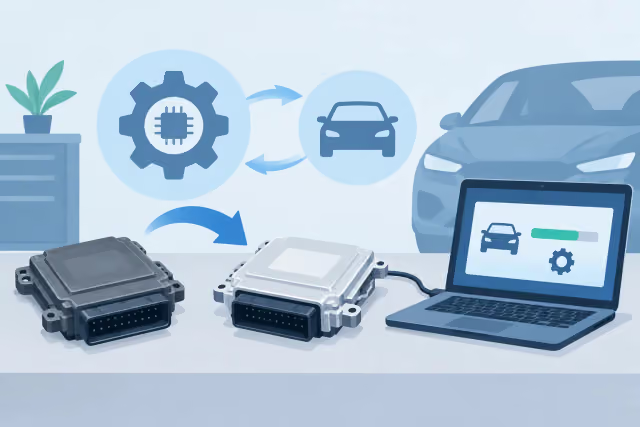
A replacement module can look identical to the failed unit, carry the same part number, and still leave a vehicle with warning lights, communication faults, or a no-start condition. Does a control module need programming? Often, yes - but the real answer depends on the module, vehicle platform, and whether you are installing a repaired original, a remanufactured replacement, or a used donor unit.
Modern vehicles rely on dozens of electronic controllers that exchange information across high-speed data networks. The engine control module, transmission control module, body control module, ABS module, TIPM, instrument cluster, and other components may store vehicle-specific information. Replacing one is not always as simple as unplugging the old part and installing another.
What Programming a Control Module Actually Means
In automotive repair, “programming” can describe several different procedures. These terms are often used interchangeably, but they are not the same service.
Programming or flashing installs the correct operating software and calibration into a module. The calibration may be specific to the vehicle’s year, engine, transmission, emissions package, axle ratio, tire size, options, or factory updates.
Coding, configuration, or setup tells a module which vehicle features it must control. A body control module, for example, may need to know whether the vehicle has remote start, fog lamps, power sliding doors, keyless entry, or a particular security system.
Some vehicles also require VIN writing, immobilizer pairing, key relearn procedures, or theft-deterrent initialization. These are security functions, not just software updates. If they are incomplete, the engine may crank without starting, or the vehicle may reject the replacement module entirely.
Finally, certain systems need relearns after installation. A transmission control module may need an adaptive learn procedure. An ABS module may require a scan-tool bleed process. An engine control module may need a crankshaft position variation relearn. These steps help the module operate correctly with the vehicle after it has been installed.
Does a Control Module Need Programming? It Depends on the Module
The correct answer starts with the specific part number and application. Two modules used in similar vehicles can have very different installation requirements.
Repaired Original Modules Usually Need Less Setup
When the original module is repairable, sending in that exact unit is often the simplest path. The module normally retains its original VIN, security information, calibration, and option configuration. Once the electronic failure has been diagnosed and repaired, it can frequently be returned to the vehicle without dealer-level programming.
That does not mean every repaired module is automatically plug-and-play. Battery disconnects, system faults, or manufacturer procedures can still require clearing codes, running a relearn, or initializing a related system. However, retaining the vehicle’s original controller avoids many compatibility and security obstacles that come with replacing it.
This is especially valuable for modules such as body control modules, instrument clusters, climate-control units, ABS modules, and engine or transmission controllers with embedded vehicle data.
Remanufactured Replacement Modules May Be Pre-Programmed
A properly prepared remanufactured module may be programmed or configured before shipment when the supplier has the necessary vehicle information and the application supports it. That can include the VIN, original part number, engine details, and other required configuration data.
A tested, correctly matched module reduces installation risk, but “ready to install” should always be understood in the context of the vehicle application. Some manufacturers require a final scan-tool routine after any replacement module is installed. Others require programming through factory software before the vehicle will start or before all features will work.
For that reason, provide complete vehicle information when ordering: year, make, model, engine, transmission when applicable, VIN, and the number printed on the original module. Accurate identification is the first step toward correct programming and fitment.
Used Donor Modules Are the Highest-Risk Option
A used module from another vehicle may physically fit and still be electronically incompatible. It may contain another VIN, different option coding, an outdated calibration, or immobilizer information tied to the donor vehicle’s keys.
Used modules can also have hidden faults. Water intrusion, heat damage, intermittent communication failures, and internal driver-circuit damage are not always visible during a basic visual inspection. A low purchase price can quickly become expensive if the module requires programming, cannot be configured, or introduces a second diagnosis.
Some modules can be cloned, reset, or reprogrammed. Others have manufacturer restrictions that make used-module installation impractical. Before purchasing a donor unit, verify that it can be used on your exact vehicle and determine whether programming capability is available.
Modules Most Likely to Require Programming or Relearns
Engine control modules and powertrain control modules commonly require programming because they contain software calibrated for a specific powertrain and emissions configuration. A replacement ECM or PCM may also require immobilizer setup and a crankshaft variation relearn.
Transmission control modules often need application-specific calibration and adaptive relearning. Without correct setup, shift quality may be poor, warning lights may remain on, or the vehicle may enter reduced-power or limp-home mode.
Body control modules and TIPM units frequently require configuration because they manage vehicle options, lighting, locks, wipers, starting authorization, and communication with other controllers. A mismatched BCM can create problems that appear unrelated to the module itself.
ABS modules may need configuration and a scan-tool bleeding procedure, particularly if the hydraulic control unit was replaced. Instrument clusters can require VIN programming, mileage transfer where legally permitted, and security synchronization. Blind-spot modules, climate-control modules, and other networked electronics may require calibration or initialization depending on the manufacturer.
Programming Is Not a Substitute for Diagnosis
A module should not be replaced just because a diagnostic trouble code names that module. Network codes, low system voltage, corroded connectors, damaged wiring, poor grounds, and failed sensors can all imitate a bad controller.
For example, an engine module may appear offline because of a blown fuse, a shorted 5-volt reference circuit, or a CAN communication fault. An ABS warning light can result from a wheel-speed sensor or damaged harness rather than an internal ABS module failure. Replacing the module first may add programming costs without correcting the actual problem.
A disciplined diagnosis should confirm power, ground, communication integrity, connector condition, and relevant input and output signals before condemning the module. Reading all vehicle codes matters because a fault in one controller can disrupt multiple systems on the network.
Programming vs. Initialization: Know What Your Shop Needs
Before ordering, ask whether the vehicle needs full programming, a VIN write, theft-deterrent relearn, coding, or only a basic initialization. These requirements determine whether the repair can be completed in a driveway, at an independent shop, or with factory-level diagnostic equipment.
Many professional scan tools can perform common relearns and service functions. Full software flashing, however, may require a manufacturer subscription, a J2534 pass-through device, stable battery voltage, and access to the correct factory calibration. Interrupting a programming event because of low voltage or poor communication can damage the module or leave it inoperable.
If programming is required, plan for it before installation. Confirm that the shop has the right equipment and current software access. This prevents a vehicle from sitting disabled while the correct service arrangement is made.
A Better Replacement Process
Start by documenting the original module’s exact part number and identifying the vehicle by VIN. Do not rely only on a broad vehicle description, because mid-year production changes and option packages can affect module compatibility.
Next, determine whether the original unit can be repaired. Preserving the original module is often the most efficient way to retain the vehicle’s stored data and minimize programming requirements. If replacement is necessary, confirm whether the replacement will arrive pre-programmed and whether any final relearn or initialization is required after installation.
Before connecting the replacement unit, inspect connectors for spread terminals, corrosion, moisture, bent pins, and harness damage. Correct any power, ground, or wiring issue that may have contributed to the original failure. Installing a replacement module into the same damaging electrical condition can lead to repeat failure.
VCM Rebuilders applies precision diagnostics, component-level repair methods, and automated test equipment to help customers avoid that cycle. For repairable original units, the goal is to restore the module’s function while preserving the vehicle-specific information already stored inside.
The practical answer is not simply yes, or no. A control module may need programming, coding, relearning, or no additional setup at all. Confirming those requirements before you order turns a potentially complicated electronic repair into a controlled, efficient installation.