
Shopping Cart
Sub Total:
$0
Total:
$0
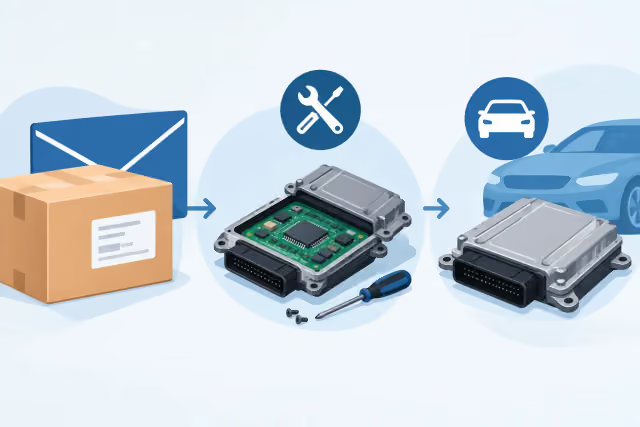
A warning light, intermittent no-start condition, dead instrument cluster, or transmission stuck in limp mode can point to a failed electronic module. The part may look simple from the outside, but vehicle modules carry calibration data, network configuration, and security information that must match the vehicle. That is why mail in automotive module repair is often a better path than replacing a module with an unknown used unit or paying dealer-level pricing for a new one.
Sending in the original module allows a qualified electronics repair facility to diagnose the actual failure, repair the unit at the component level when possible, and return the same module for installation. Preserving the original unit can reduce compatibility problems and avoid unnecessary programming in many applications.
How Mail In Automotive Module Repair Works
The process starts with identifying the correct module and confirming that the vehicle symptoms support module diagnosis. An engine control module, transmission control module, body control module, ABS module, TIPM, instrument cluster, climate-control module, or blind-spot sensor can fail in ways that resemble wiring, battery, sensor, actuator, or network faults. A proper diagnosis before removal saves time and prevents sending in a functional module.
Once the module is removed, the customer ships the original unit to the repair center with the required order and vehicle information. Technicians inspect the unit, document its condition, and evaluate it using known failure patterns, circuit-level diagnostics, and application-specific test procedures. The goal is not to clear a code or perform a cosmetic repair. It is to locate the electronic failure mode affecting vehicle operation.
After repair, the module is tested to verify that the affected functions respond correctly. Depending on the component, testing may include power-up behavior, communication circuits, input and output simulation, internal memory operation, motor-driver performance, gauge operation, or network communication. The repaired module is then returned for reinstallation.
Why Repairing Your Original Module Matters
Modern vehicle electronics are rarely interchangeable by appearance alone. Two modules with the same connector style may have different hardware revisions, software strategies, option content, or calibration requirements. Some also contain vehicle-specific data tied to the VIN, anti-theft system, key programming, mileage, or configuration.
Repairing the original unit retains information already matched to the vehicle whenever the module and memory are recoverable. This can make installation more straightforward than installing a replacement module that requires programming, configuration, immobilizer setup, or a dealer scan tool.
There are exceptions. Severe water intrusion, fire damage, collision damage, missing components, or unrecoverable memory corruption can make repair impractical. In those cases, a correctly matched remanufactured replacement may be the more dependable option. The right answer depends on the module’s condition, the vehicle application, and whether vehicle-specific data can be retained or transferred.
Modules Commonly Sent In for Repair
Mail-in service is especially useful for modules with repeatable electronic failure modes. Engine and powertrain controllers may develop internal driver failures, no-communication conditions, heat-related intermittent faults, or corrupted circuitry. Transmission control modules can contribute to shift issues, limp mode, solenoid control faults, and loss of communication.
ABS modules may have pump-driver, communication, or internal circuit failures that trigger ABS, traction-control, or brake warning lights. Body control modules and TIPM units can cause erratic lighting, wiper, door-lock, horn, fuel-pump, or accessory operation. Instrument clusters may suffer from blank displays, failed gauges, intermittent backlighting, warning-light concerns, or loss of odometer display.
The symptom alone does not prove the module is at fault. For example, low system voltage can cause misleading module codes across multiple systems. Corroded connectors, damaged wiring, poor grounds, failed sensors, and CAN network faults must be considered before the module is removed.
Before You Remove and Ship the Module
A little preparation protects the repair process and helps the technician evaluate the unit correctly. Record all diagnostic trouble codes before disconnecting the battery or removing the module. Note when the problem occurs, whether it is constant or intermittent, and what systems are affected. Details such as “no crank after rain,” “speedometer drops to zero after 20 minutes,” or “ABS light returns after a short drive” are useful diagnostic evidence.
Verify battery condition and charging voltage first. Electronics can behave unpredictably when voltage is low, connections are loose, or grounds are compromised. Inspect accessible connectors for bent pins, moisture, corrosion, pushed-out terminals, and damaged locks. If the vehicle has aftermarket remote start equipment, audio wiring, lighting modifications, or prior collision repairs, include that information as well.
When removing the module, disconnect battery power according to the vehicle service procedure. Handle the unit by its housing and connectors rather than pressing on circuit-board areas. Do not open the module, scrape away protective sealant, or attempt to reflow solder with household tools. Uncontrolled heat can damage boards, memory devices, and delicate components, turning a repairable failure into a replacement-only situation.
Package the module in an anti-static bag if available, then use adequate padding in a sturdy box. Include the order details, vehicle year, make, model, engine size, transmission information when relevant, the module part number, and a clear description of the symptoms. Accurate information supports correct testing and helps prevent delays caused by incomplete identification.
What Precision Repair Should Include
A dependable repair service does more than replace an obvious burned component. Automotive modules operate in harsh electrical and thermal environments. The underlying fault may involve a cracked solder joint, failed capacitor, damaged output driver, shorted protection circuit, compromised communication transceiver, worn connector connection, or failure inside a power-supply section.
Precision repair begins with inspection and failure-mode diagnosis. Components are evaluated against the module’s circuit function, not simply swapped by guesswork. Where known weaknesses exist, repair may also include appropriate upgrades to improve long-term reliability. The repaired unit should then be tested using equipment designed to reproduce relevant vehicle inputs and outputs.
VCM Rebuilders applies reverse-engineering experience, electronic failure-mode diagnostics, and automated test equipment to evaluate repairable automotive electronics. For the customer, that technical work should lead to a practical result: a module returned tested and ready for installation whenever the application allows.
Repair Versus Replacement: Making the Right Call
Repair is often the preferred option when the original module is available, the fault is confirmed, and preserving original configuration matters. It can be cost-effective and can reduce the risk of receiving an incorrectly matched unit. It is also a more sustainable choice because it keeps a repairable electronic component in service rather than replacing it unnecessarily.
Replacement may be the better choice when the original unit is physically destroyed, missing, previously damaged by an unsuccessful repair attempt, or beyond recovery. A remanufactured replacement should be selected by exact vehicle fitment and part number, then tested before shipment. Ask whether programming or setup will be required after installation, particularly for powertrain, body, and security-related modules.
Used modules can appear inexpensive, but the purchase price is only part of the equation. A used module may have the same hidden failure, incompatible calibration, incorrect options, or unknown history. If it requires programming and still does not solve the problem, the vehicle remains down and labor costs increase.
Set Realistic Expectations for Installation
Even a correctly repaired module cannot correct an unrepaired vehicle-side issue. If a harness is shorted, a wheel-speed sensor is failed, a charging system is overvolting, or water is entering a connector, the original condition can return after installation. Resolve related wiring, power, ground, and component faults before putting the module back into service.
Some vehicles may require a relearn, calibration, scan-tool initialization, or code clearing after reinstallation. Follow the vehicle manufacturer’s service procedures, especially for safety systems, anti-theft functions, and powertrain controls. If you are unsure about the installation steps, a qualified technician can help confirm the repair and protect the vehicle from avoidable damage.
The best mail-in repair experience begins with accurate diagnosis and ends with careful reinstallation. Save the codes, document the symptoms, package the original module correctly, and provide complete vehicle information. Those few steps give the repair team what it needs to return a tested solution that gets the vehicle back to doing its job.